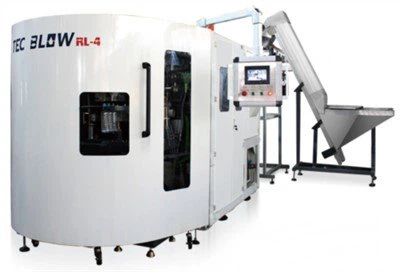
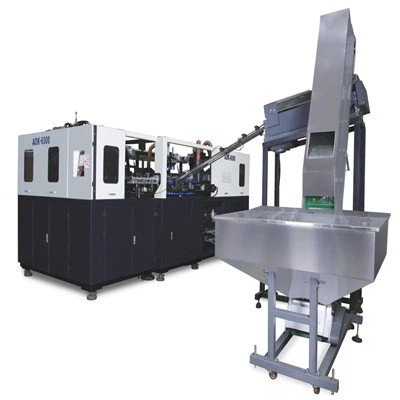
A bottle molding machine is a type of machine used in the manufacturing process of PET (polyethylene terephthalate) bottles. It operates through a two-stage process that involves the injection of heated plastic resin into a mold to create a preform, which is then stretched and blown into the final bottle shape. The machine can produce various types of bottles, including water bottles, soft drink bottles, juice bottles, and personal care product bottles. Bottle molding machines are widely used in industries such as beverage production, food processing, and cosmetic manufacturing.
Specifications
|
Model |
Unit |
TEC BLOW RL-4 5L |
|
| Clamping System |
(Number of cavity) |
cavities |
4 |
|
(mold stroke) |
mm |
0-200 |
|
|
(stretch stroke) |
mm |
360 |
|
|
(Bottom stroke) |
mm |
50 |
|
|
(Cavity pitch) |
mm |
203.2 |
|
|
(heating pitch) |
mm |
76.2 |
|
|
(Number of holder) |
PCS |
96 |
|
| Container |
(Max.container volume) |
ltr |
5 |
|
(Max. neck diameter) |
mm |
48 |
|
|
(Max.prefrom height) |
mm |
160 |
|
|
(Max.container diameter) |
mm |
180 |
|
|
(Max.container height) |
mm |
360 |
|
|
(actual output) |
B.P.H |
3000 |
|
| Electrical System |
(heating oven) |
UNITS |
8 |
|
(box*channel) |
Floor |
12 |
|
|
(Number of lamp) |
pcs |
96 |
|
|
(heating power) |
KW |
129 |
|
|
AVERAGE POWER |
KW |
65 |
|
|
(installed power) |
KW |
139 |
|
|
(voltage) |
Voltage |
220v/380V/3 phase |
|
| Air System |
(operating pressure) |
kg/cm2 |
7 |
|
(blowing pressure) |
mpa |
3.8 |
|
|
(high pressure air consuming) |
L/min |
9000 |
|
| Chiller System |
(temperature) |
°C |
10-15 |
|
(pressure) |
Mpa |
0.4 |
|
|
(flow rate) |
L/min |
80 |
|
|
(heating power) |
HP |
5 |
|
| Machine |
(L×W×H) (machine dimension) |
M |
3.3*2.2*2.5 1.0*3.0*2.5 |
|
(machine weight) |
KG |
8500 |
|

Taizhou Dalgakiran Packaging Machinery Co., Ltd. is a high-quality manufacturer with 24 years of production experience, specializing in the production of various PET blow molding machines and blow molds, which can be applied to food packaging bottles, mineral water bottles, juice bottles, etc. The company has its own mold design team and multiple high-precision equipment, and has obtained ISO9001 and CE certification.
Why Choose Us?
Advanced Equipment
We have multiple high-precision equipment, such as Mitutoyo height gauge, three-dimensional coordinate measuring instrument, roundness meter, CNC milling machine, etc.
Product Application
Food packaging bottles, edible oil bottles, soda and mineral water bottles, juice bottles, wine bottles, cosmetic bottles, etc.
Quality Control
Strictly inspect every link according to the quality system to ensure compliance with the highest standards.
Features And Advantages Of Bottle Moulding Machine
The features and advantages of a bottle molding machine include:
1.High Productivity: Bottle molding machines are designed for high-speed production, allowing for a large number of bottles to be produced in a relatively short period of time. This helps meet the demands of industries with high volume production requirements.
2.Versatility: These machines can produce bottles of various sizes, shapes, and capacities, making them suitable for a wide range of applications. They can be easily adjusted to accommodate different bottle designs and specifications.
3.Precise Control Over Bottle Dimensions: Bottle molding machines offer precise control over the thickness, weight, and dimensions of the bottles being produced. This ensures consistency in product quality and allows for customization according to specific requirements.
4.Energy Efficiency: Many modern bottle molding machines are designed to be energy-efficient, incorporating features such as servo motors, variable frequency drives, and optimized heating systems. This helps reduce energy consumption and operational costs.
5.Automation And Ease Of Operation: Bottle molding machines often feature automated processes, including automatic preform loading, mold changing, and bottle ejection. This reduces the need for manual labor and increases production efficiency. User-friendly interfaces and intuitive controls make the machines easy to operate and monitor.
6.Quality Assurance: Bottle molding machines employ advanced technologies and mechanisms to ensure the production of high-quality bottles. These may include system checks for defects, automated rejection of faulty bottles, and control systems for temperature, pressure, and stretch ratios.
7.Durability And Reliability: Bottle molding machines are built to withstand continuous operation in demanding industrial environments. They are constructed with robust materials and undergo rigorous testing to ensure reliability and longevity.
8.Cost-effectiveness: With their high production capacity and efficiency, bottle molding machines offer cost-effective solutions for bottle manufacturing. They help reduce labor costs, minimize material waste, and optimize production processes.
9.Safety Features: Bottle molding machines are equipped with safety features such as emergency stop buttons, safety interlocks, and protective enclosures. These ensure the safety of operators and prevent accidents during operation.
Common types of Bottle Moulding Machine
There are several common types of bottle molding machines used in the manufacturing process. These include:
Linear Bottle Molding Machines
Linear bottle molding machines are designed to produce bottles in a linear fashion. They are suitable for low to medium production volumes and can produce bottles with capacities ranging from small to large.
Rotary Bottle Molding Machines
Rotary bottle molding machines are designed to produce bottles in a rotary fashion. They are suitable for high-volume production and can produce bottles with capacities ranging from small to large.
Stretch Blow Molding Machines
Stretch blow molding machines use a process that involves stretching and blowing a preform into the shape of the final bottle. They are used to produce bottles with high clarity and strength, making them ideal for applications such as water bottles and carbonated beverage bottles.
Injection Blow Molding Machines
Injection blow molding machines use a process that involves injecting molten plastic resin into a mold to create a preform, which is then stretched and blown into the final bottle shape. They are often used to produce small to medium-sized bottles.
Extrusion Blow Molding Machines
Extrusion blow molding machines use a process that involves extruding molten plastic through a die to create a tube-shaped parison, which is then molded into the final bottle shape. They are used to produce bottles with large capacities and irregular shapes.
Reheat Stretch Blow Molding Machines
Reheat stretch blow molding machines use a process that involves re-heating a preform and stretching it into the final bottle shape. They are often used to produce bottles with complex shapes and designs.
Components of bottle molding machine
The components of a bottle molding machine can vary depending on the specific design and manufacturer. However, here are some common components that you will typically find in a bottle molding machine:
Extruder: This is the part of the machine responsible for melting and plasticizing the raw material, usually in the form of plastic pellets or preforms. It consists of a screw and barrel system.
Die Head: The die head is where the molten plastic material is formed into a parison, which is a tube-like shape that will be inflated to create the bottle. The die head controls the thickness and shape of the parison.
Clamping Unit: The clamping unit holds the mold in place during the blow molding process. It consists of two plates or halves that close together to secure the mold. The clamping unit also provides the necessary force to hold the mold closed during the blowing process.
Blow Station: This is where the inflation of the parison takes place. Compressed air is blown into the parison, causing it to expand and take the shape of the mold cavity.
Cooling System: After the bottle has been formed, it needs to cool down and solidify. The cooling system typically includes water circuits or cooling fans that help to dissipate heat from the mold and the newly formed bottle.
Ejection System: Once the bottle has cooled and solidified, it needs to be removed from the mold. The ejection system helps in separating the bottle from the mold, either by using mechanical ejector pins or by applying air pressure.
Control Panel: The control panel houses the electrical and electronic components that control the operation of the machine. It allows operators to set and adjust various parameters such as temperature, pressure, cycle time, and other process variables.
Conveyor System: In automated systems, a conveyor system is often used to transport the bottles between different stages of the production process, such as from the mold to the cooling station or from the cooling station to the packaging area.
Safety Features: Bottle molding machines are equipped with various safety features to ensure the safety of operators and prevent accidents. These may include safety interlocks, emergency stop buttons, guarding, and sensors to detect abnormalities or malfunctions.
Craftsmanship of Bottle Moulding Machine
Design And Engineering
Bottle molding machines require careful design and engineering to ensure their functionality and efficiency. Skilled engineers use advanced CAD software and modeling techniques to create precise machine designs that optimize performance and meet industry standards.
Material Selection
High-quality materials are essential for the construction of bottle molding machines. The selection of robust metals, such as stainless steel or cast iron, ensures the machine's structural integrity, resistance to wear and tear, and longevity.
Precision Machining
The components of bottle molding machines, including molds, platens, cylinders, and valves, are machined to precise specifications. Skilled machinists use precision tools and CNC (Computer Numerical Control) machines to achieve accurate dimensions, smooth surfaces, and tight tolerances.
Assembly And Alignment
During assembly, highly skilled technicians meticulously fit and align the various components of the machine. Proper alignment ensures smooth operation, minimizes friction, and prevents premature wear.
Electrical And Control Systems
Craftsmanship is also required in the installation and wiring of electrical and control systems. Experienced electricians and technicians carefully connect motors, sensors, actuators, controllers, and other electrical components to ensure proper functioning and safety.
Testing And Quality Assurance:
Before leaving the manufacturing facility, bottle molding machines undergo rigorous testing and quality checks. Skilled technicians perform functional tests, calibration checks, and stress tests to ensure that the machines meet performance specifications and comply with safety standards.
Maintenance is essential to keep bottle molding machines in optimal working condition and extend their lifespan. Here are some key aspects of maintaining a bottle molding machine:
1.Regular Cleaning: Clean the machine regularly to remove dust, debris, and residues that can accumulate on various components. Use appropriate cleaning agents and methods recommended by the manufacturer to avoid damaging sensitive parts.
2.Lubrication: Proper lubrication of moving parts is crucial to reduce friction and prevent excessive wear. Follow the manufacturer's guidelines for lubrication intervals and use the recommended lubricants to ensure smooth operation.
3.Inspection And Adjustment: Conduct routine inspections of the machine to identify any signs of wear, loose fasteners, or misalignment. Tighten loose parts, adjust settings if necessary, and replace worn-out components to maintain optimal performance.
4.Mold Maintenance: The molds used in bottle molding machines require regular inspection and maintenance. Clean the molds after each production run to remove any residual material. Check for any signs of damage, wear, or corrosion, and repair or replace the molds as needed.
5.Cooling System Maintenance: The cooling system of the machine, including water channels and cooling fans, should be inspected and cleaned regularly. Ensure proper water flow, clean or replace filters, and check for leaks to maintain efficient cooling.
6.Electrical And Control System Maintenance: Inspect electrical connections, cables, and control panels for any signs of wear, damage, or loose connections. Keep the electrical components clean and free from dust. Perform regular checks on sensors, actuators, and safety devices to ensure their proper functioning.
7.Training And Operator Care: Provide proper training to machine operators on the correct operation and maintenance procedures. Encourage operators to report any abnormalities promptly and perform daily checks on machine performance, temperature, pressure, and other critical parameters.
8.Documentation And Record-keeping: Maintain a comprehensive maintenance log that records all maintenance activities performed on the machine. This helps track maintenance schedules, identify recurring issues, and plan future maintenance tasks.
9.Scheduled Maintenance And Servicing: Follow the manufacturer's recommended maintenance schedule for major servicing and overhaul. Engage qualified technicians or service personnel to perform these tasks, which may include replacement of critical components, calibration, and thorough inspections.


FAQ
Q: What is a bottle molding machine?
Q: How does a bottle molding machine work?
Q: What types of bottles can be produced by a bottle molding machine?
Q: What are the advantages of using a bottle molding machine?
Q: What materials can be used in a bottle molding machine?
Q: What is the production capacity of a bottle molding machine?
Q: How can I ensure the quality of bottles produced by a bottle molding machine?
Q: Can a bottle molding machine produce bottles of different sizes and shapes?
Q: What safety measures should be taken when operating a bottle molding machine?
Q: What maintenance tasks are required for a bottle molding machine?
Q: How long does a bottle molding machine last?
Q: Can bottle molding machines be customized to meet specific production requirements?
Q: Can a bottle molding machine be fully automated?
Q: What are the common troubleshooting issues with bottle molding machines?
Q: Can a bottle molding machine produce bottles with different colors?
Q: What is the energy consumption of a bottle molding machine?
Q: Are bottle molding machines environmentally friendly?
Q: Can bottle molding machines be used for other applications besides bottles?
Q: How can I choose the right bottle molding machine for my production needs?
Q: Are there any safety certifications or standards that bottle molding machines should meet?
Hot Tags: tec blow rl-4 5l bottle moulding machine, China tec blow rl-4 5l bottle moulding machine manufacturers, suppliers, factory